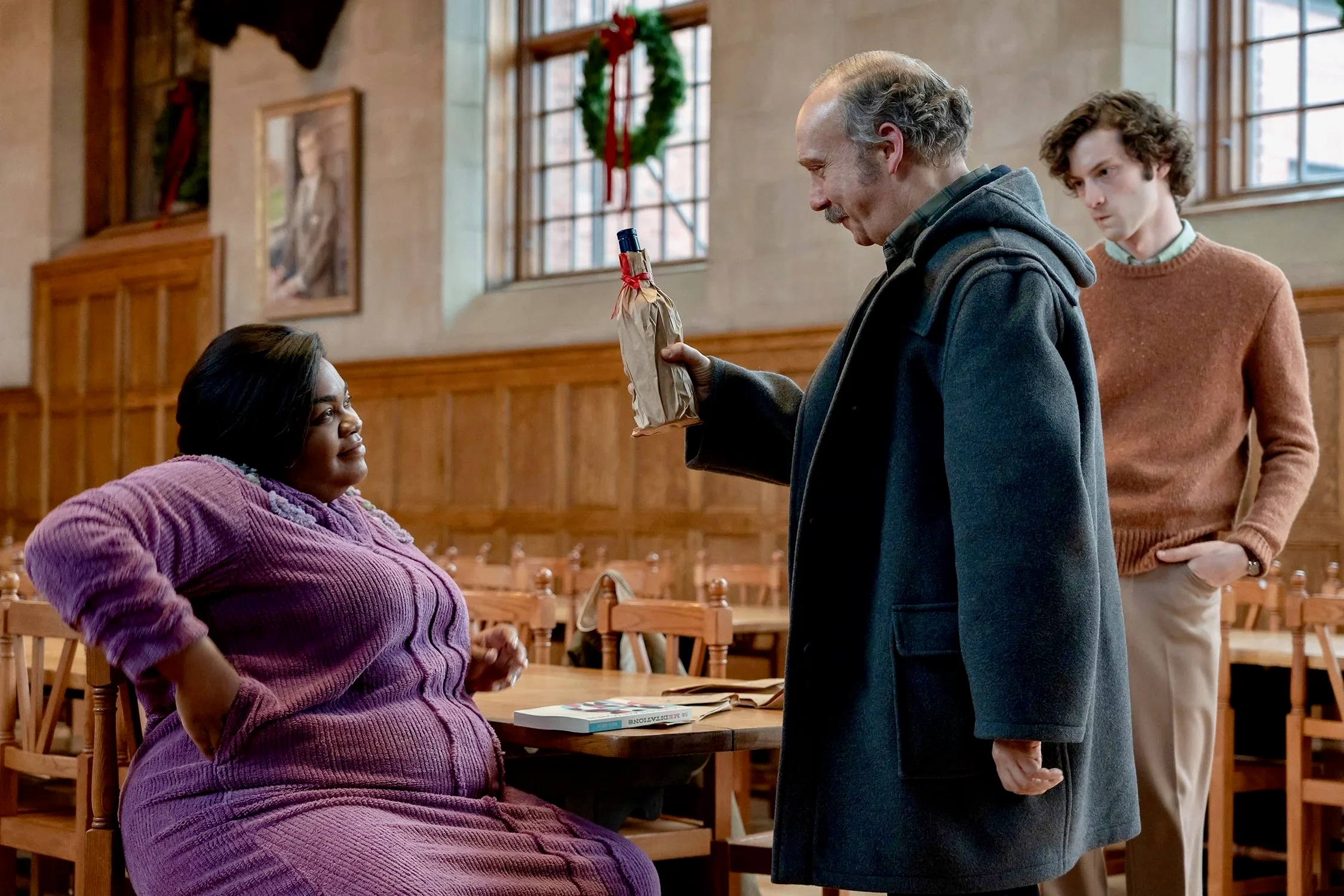
I know it’s technically a Christmas movie. But somehow, The Holdovers stayed with me long after Christmas was over.
There are movies you watch, enjoy, and move on from.
Then there are movies that quietly follow you around.
The Holdovers was one of those movies for me.
Yes, I know it’s a Christmas movie. I know the story takes place during the holiday season at a New England boarding school. I know it was released as a Christmas film.
But honestly?
I didn’t experience it as a Christmas movie.
I experienced it as a movie about people.
People who are lonely.
People who are grieving.
People who are misunderstood.
People who are difficult.
People who are caring.
People who are hurting and don’t necessarily know how to say, “I’m hurting.”
And maybe that’s why it connected with me so much.
Because the older I get, the more interested I become in the pieces of people we don’t immediately see.
That’s really what Puzzle Piece Perception is about.
We see a piece of someone and assume we’ve figured out the picture.
But what if we haven’t?
The Three People We Think We Know
The Holdovers, directed by Alexander Payne and written by David Hemingson, brings three unlikely people together over Christmas break.
Paul Hunham, played brilliantly by Paul Giamatti, is a rigid, cranky history teacher who has been left behind at the fictional Barton Academy to supervise students who can’t go home for the holidays.
Angus Tully, played by Dominic Sessa in his remarkable film debut, is a teenage student who ends up staying behind.
And then there’s Mary Lamb, played by Da’Vine Joy Randolph.
Mary is the school’s cook.
At first glance, those descriptions seem pretty straightforward.
Teacher.
Student.
Cook.
Three pieces.
But that’s not the whole picture.
And that’s where the movie got me.
Puzzle Piece One: Pay Attention to What People Need
Mary Lamb was probably the character who stayed with me the most.
There’s something about the way Mary pays attention.
She notices people.
She notices what they eat.
She notices when someone needs something.
She notices the emotional temperature in the room.
She doesn’t necessarily make a big speech about caring. She simply does it.
She feeds people.
She checks on people.
She creates warmth.
And there’s something deeply human about that kind of attentiveness.
Sometimes caring for somebody isn’t about having the perfect thing to say.
Sometimes it’s noticing that they haven’t eaten.
Sometimes it’s making sure they have a plate.
Sometimes it’s remembering something small they told you three days ago.
Sometimes it’s simply saying, “You okay?”
And Mary does all of this while carrying an enormous grief of her own.
Her son Curtis, a former Barton student, has died while serving in Vietnam.
That changes the way I see her.
Because Mary isn’t simply the cook.
She’s a mother who lost her son.
She’s grieving.
She’s working.
She’s showing up.
And somehow, even while carrying her own pain, she’s still paying attention to everybody else’s needs.
That really hit me.
How many people do we know like that?
People who are always checking on everybody else.
People who remember everybody’s birthday.
People who bring the food.
People who ask, “Did you get home okay?”
People who somehow know when something is wrong before you ever say it.
We sometimes call people like that “the strong one.”
But strength doesn’t mean they don’t need care.
Sometimes the person taking care of everybody else is the person we should be asking, “Who is taking care of you?”
That’s the first Puzzle Piece.
Pay attention to what people need, not just what they say.
People don’t always ask for what they need.
Sometimes they show you.
You just have to be paying attention.
Puzzle Piece Two: Don’t Mistake the First Piece for the Whole Person
Then there’s Paul Hunham.
And listen…
Paul is annoying.
😂
There were moments when I wanted to reach through the screen and say, “Paul, please go take a walk.”
He’s rigid.
He’s judgmental.
He’s sarcastic.
He’s difficult.
He seems determined to make everybody around him uncomfortable.
And yet, as the movie unfolds, you begin to see more.
You start getting pieces of his story.
His loneliness.
His history.
His relationship with Barton.
His complicated connection to the world around him.
And eventually, you realize that the person you initially categorized as simply “a difficult man” is much more complicated than that.
That’s the thing about people.
We love categories.
Good person.
Bad person.
Nice person.
Mean person.
Selfish person.
Difficult person.
But human beings don’t work that way.
Paul can be difficult and compassionate.
He can be arrogant and vulnerable.
He can frustrate you and still care deeply.
Understanding that doesn’t mean excusing his behavior.
And that’s an important distinction.
Understanding somebody is not the same as excusing somebody.
You can recognize that someone’s behavior isn’t okay while still understanding that there’s probably more to their story than the behavior you’re seeing.
That’s Puzzle Piece Perception.
You don’t throw away the piece you don’t like.
You ask yourself what the rest of the picture might look like.
And Then There’s Angus
Angus is probably the easiest character to judge at first.
He’s a teenager.
He’s angry.
He’s sarcastic.
He’s impulsive.
He’s hurting.
And honestly, he’s a teenager.
What else are we expecting?
But underneath all of that is a kid trying to make sense of rejection, disappointment, family, loneliness, and the confusing transition between childhood and adulthood.
And that’s another thing the movie gets right.
Sometimes what looks like bad behavior is actually pain that doesn’t know how to introduce itself.
That doesn’t mean every bad behavior should be tolerated.
It means we should become curious before we become certain.
There’s a difference.
People Are Rarely Just One Thing
Maybe that’s what I loved most about The Holdovers.
Nobody is presented as a perfect human being.
Nobody gets to be just one thing.
Mary isn’t just the nurturing cook.
Paul isn’t just the difficult teacher.
Angus isn’t just the troubled kid.
They’re all carrying things.
They’re all revealing pieces.
And as they spend more time together, those pieces begin to form a picture none of them could have seen at the beginning.
That’s life, isn’t it?
We meet people and make assumptions.
We decide who they are based on a conversation.
A facial expression.
A bad day.
A social media post.
A mistake.
A reputation.
And sometimes we’re right.
But sometimes we’re only looking at one puzzle piece.
The People Who Irritate Us Can Still Teach Us Something
This is probably the hardest lesson for me.
Sometimes the person who irritates us the most can teach us something about ourselves.
Not because they’re necessarily right.
Not because we need to keep them in our lives.
Not because every difficult relationship needs to be repaired.
But because our reaction to someone can reveal something worth examining.
Maybe they remind us of someone.
Maybe they challenge something we believe.
Maybe they represent a quality we don’t like.
Maybe they force us to practice boundaries.
Maybe they simply teach us what we don’t want to become.
We don’t have to love every piece of the picture to understand what the picture is trying to show us.
What Mary Really Taught Me
But I keep coming back to Mary.
Because there’s something beautiful about a person who notices.
In a world where everyone seems to want to be heard, noticed, validated, liked, followed, and acknowledged, there is something incredibly powerful about being the person who notices someone else.
Mary pays attention.
And maybe that’s a form of love we don’t talk about enough.
Not grand gestures.
Not inspirational speeches.
Just attention.
You noticed I wasn’t hungry.
You remembered my favorite thing.
You could tell I was having a bad day.
You made sure I had somewhere to sit.
You asked how I was doing and actually waited for the answer.
That’s love too.
Sometimes love looks like paying attention.
Maybe That’s Why The Holdovers Stayed With Me
I think that’s why this movie stuck with me.
It wasn’t really about Christmas.
It was about what happens when three people who initially have very little in common are forced to slow down long enough to actually see one another.
And isn’t that what we rarely do?
We see.
But we don’t always look.
We hear.
But we don’t always listen.
We encounter.
But we don’t always understand.
We see the piece and assume we know the picture.
Maybe Puzzle Piece Perception is simply an invitation to pause before we decide.
To ask better questions.
To look a little longer.
To notice what isn’t being said.
To remember that the person in front of us may be carrying a story we know absolutely nothing about.
And maybe, just maybe, the person who seems the most difficult has a piece of their story we’ve never been given.
The person who seems the strongest may be exhausted.
The person who seems angry may be grieving.
The person who seems distant may be protecting themselves.
The person who seems like they don’t need anybody may desperately need someone to notice.
We don’t have to excuse people.
We don’t have to tolerate bad behavior.
We don’t have to keep everyone in our lives.
But we can become better at seeing people as whole human beings.
Because sometimes the piece that’s confusing you isn’t meant to be understood by itself.
You have to step back and look at the whole picture.
That’s Puzzle Piece Perception.
And maybe that’s what The Holdovers gave me this year:
A reminder that sometimes the greatest thing we can give another person isn’t advice.
It’s attention.
It’s curiosity.
It’s compassion.
It’s simply taking the time to see them.
More on Puzzle Piece Perception (PPP).


Leave a Reply